Climate action that includes people with disabilities
Daura van Vuuren is a Dutch researcher working where climate change and disability inclusion meet. People with disabilities are two to four times more likely to die or be injured in a climate emergency, yet most national climate plans don’t mention them. With a Bevica scholarship she travelled through the US, Canada, Indonesia, Australia, Fiji and New Zealand-Aotearoa to collect their stories and build the case for climate policy that leaves no one behind.
“Effective climate action is inclusive climate action.”
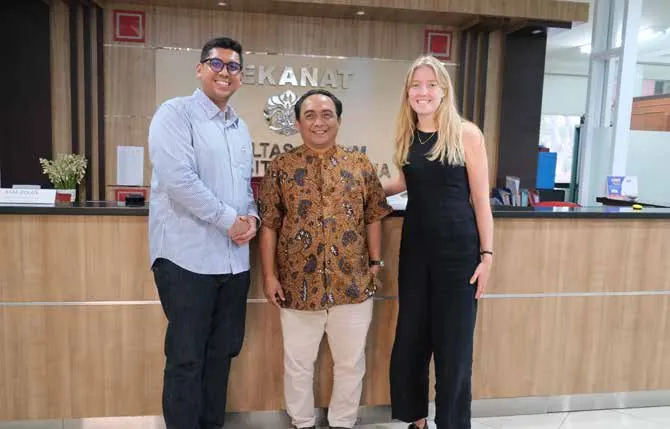
Daura van Vuuren (26) is a Dutch researcher dedicated to exploring the intersection between climate change and disability inclusion. With a Master of Science in Climate Change: Impacts, Mitigation and Adaptation and a Bachelor of Arts in Liberal Arts and Sciences: Global Challenges (majoring in World Politics), she combines insights from both social and natural sciences to address complex sustainability challenges through interdisciplinary approaches.
In 2024, as a Bevica Main Student Prize recipient, receiving a grant of 42.000 euros, Daura embarked on a global research journey to investigate disability-inclusive climate action. Her personal connection to inclusivity, having grown up with a brother with Down syndrome, continues to shape her perspective on accessibility and justice in climate policy. Her fieldwork has taken her across North America, the Pacific, Asia and Oceania. Collaborating with local disability communities and organizations such as the Harvard Project on Disability, World Institute on Disability and the Disability-Inclusive Climate Action Research Program (DICARP) at McGill University.
Daura currently works at Nordic Sustainability, a small sustainability consultancy based in Copenhagen, where she focuses on building bridges between research, policy, and practice. Through her work, she aims to close the existing research and policy gap that too often leaves people with disabilities out of global climate conversations. Her mission is to foster a more inclusive and resilient climate movement, where every voice is represented and every solution considers both environmental and social sustainability.
Motivation
Where does your passion and motivation come from?
Daura: “I grew up in the Netherlands with two brothers and a sister. Joran, my oldest brother, has Down syndrome and growing up with a family member with a disability gave me personal insight into the importance of inclusion. I grew up in a home where differences were embraced and celebrated, and that has influenced everything I do. In 2021, I moved to Copenhagen to pursue an MSc in Climate Change at the University of Copenhagen. During my studies, I realized that discussions about marginalized groups rarely mentioned disability. This stuck with me especially, given my family context.
The pandemic highlighted how crises disproportionately affect certain groups, particularly people with disabilities. The more I learned about climate change impacts, the more I began thinking about how a climate crisis would affect my brother. He, amongst many others, would experience challenges differently, requiring specific support and accessible services that are often overlooked in emergency planning and structural support. That realization made me question, how can we ensure that climate policies are truly inclusive for everyone, addressing the specific needs of people with disabilities?
I participated in a scholarship program on Universal Design – the human rights principle that products, services, and environments should be accessible to everyone. Although the program mainly targeted architects and designers, I focused on policy measures and was determined to explore how disability inclusion intersects with climate action. I soon discovered a major research gap: disability is almost entirely absent from climate measures and policy discussions.”
About the project: Disability-Inclusive Climate Action
Can you explain what the Disability-Inclusive Climate Action project is all about?
Daura: “People with disabilities are two to four times more likely to die or be injured during a climate emergency, a shocking statistic that doesn’t even include the slow-onset impacts of climate change. The heightened risks stem from huge knowledge gaps and a major political blind spot.
I came across the work of the DICARP at McGill University, which analyzed national climate plans and adaptation policies under the Paris Agreement to assess disability inclusion. The findings were striking: very few countries mention disability in their climate policies, and many, including Denmark and the Netherlands, fail to do so entirely. Shocked by this lack of attention and accountability, I wrote a research proposal on legal accountability, exploring the possibility of a case against the Danish state for failing to protect the rights of persons with disabilities under the Paris Agreement and the UN Convention on the Rights of Persons with Disabilities. I jokingly called it my “go big or go home” approach but it landed me the scholarship grant and became the foundation of my project.
The research for the legal case involved investigating how other countries address disability inclusion in climate action, a gap in the Danish state, and the risks its citizens face due to inaction. In collaboration with DICARP, I developed a plan to travel internationally and meet experts and advocacy groups in person to inform legal arguments. Traveling across the US, Canada, Indonesia, Australia, Fiji, and New Zealand-Aotearoa, I documented how climate risks exacerbate structural challenges for people with disabilities and explored initiatives for inclusive, participatory climate action.
The Bevica scholarship enabled me to travel the world and connect with leading researchers and advocates, collecting stories from people with disabilities. I wanted to understand what happens on the ground beyond policy documents and learn from grassroots movements driving real change. Meeting experts and disability advocates revealed from the start that inaction has life-or-death consequences. One San Francisco activist’s words shook me to my core: “In my community, I’ll be the first to die, and I don’t think anyone cares.” This underscored the urgency: people with disabilities are among the most vulnerable to climate impacts, yet most national plans overlook them entirely. That is a reality we need to change.
Since starting this project, I have learned enormously from every conversation. It has become a lifelong mission: expanding the international interdisciplinary network, closing knowledge gaps, and ensuring climate policy is truly inclusive. Amplifying unheard voices so no one is left behind in the transition to a green and sustainable future.”
What is the connection between your work and nature-based solutions?
Daura: “A key part of my impact project is applying a Universal Design approach to climate action. It’s a human-centered perspective recognizing that our abilities constantly change. During a heatwave, for example, it’s not only people with disabilities at risk, but also the elderly, young children, pregnant women, and people taking medications that affect their ability to regulate body temperature. Climate adaptation therefore concerns all of society. Inclusive solutions can transform the built environment, integrate nature-based solutions, and expand green spaces. In doing so, we make everyday life more resilient, better prepared for climate impacts, and ultimately improve both safety and quality of life.”
What do you find the most enjoyable or inspiring about this initiative?
Daura: “Taking the Universal Design lens, rooted in care and love for others, and applying it to the complex challenge of climate change has shown me how it can shift perspectives. During a trip to Los Angeles, I asked an Uber driver about wildfires: “Have they affected you personally? In your family or community, is there anyone who would need extra support in an emergency?” He shared how wildfires could impact his elderly mother, children, and sick brother. We discussed whether he would want local or national policies to protect his family in light of climate impacts. Before dropping me off, he admitted, “Before today, I never understood why I had to care about climate change, but now I see it’s about taking care of my family.” Moments like that show the power of framing climate action through lived experiences.
Since returning to Copenhagen, I’ve worked to bring this conversation into new spaces, connecting with human rights activists in Denmark, giving presentations, and strategically organizing resources and stakeholders for the legal case. I am also building a platform, compiling the stories I’ve collected into a short book, and exploring a documentary to highlight the real human impact of climate change and inspire inclusive action for all.”
Context
You mentioned earlier that with this project you also want to raise awareness about the gap between policy and practice — can you elaborate on that?
Daura: “The plan is to create a short information booklet as a compact introduction to disability-inclusive climate action. It will highlight the most urgent risks, show what happens in practice, and convey a key message: climate policy must be inclusive, or the most vulnerable are left behind, facing deadly risks. The topic is highly interdisciplinary, so the booklet aims to provide an accessible yet comprehensive overview of what’s needed to inform a broad audience. Many people still ask, “How are disability and climate connected?” and this booklet addresses exactly that, illustrating how pressing crises like housing shortages, struggling healthcare, inaccessible infrastructure, discrimination, and structural inequalities intersect with climate impacts on people with disabilities. Based on my research travels, I outline these trends to show that intersectional, cross-sectoral approaches are essential when designing innovative and inclusive solutions.”
How do you envision inclusivity being standard in climate policy?
Daura: “For me, inclusivity means involving marginalized groups earlier and more effectively in policy design. The green transition is an opportunity to rethink systems, making cities, transport, infrastructure, and everyday life more accessible and socially inclusive. For example, in Auckland I saw a green space project co-developed with the local community, including marginalized groups, designed to be accessible, usable, and meaningful. Anchoring inclusivity in climate policy asks the key question: how can climate adaptation and green transition projects serve everyone, leaving no one behind?”
What do you think needs to change structurally, and what do you hope to achieve with this project?
Daura: “I believe one of the most important goals is raising awareness, a legal case is a means to that end, not the end itself. It’s about creating visibility and showing the world the reality people with disabilities face in climate crises. Media attention and public awareness are as crucial as political action to highlight the disproportionate risks of climate change. I hope to continue this work because even a single conversation can open minds and drive change. The scholarship has allowed me to collect stories worldwide and start connecting the dots in this complex context. I’m exploring cross-sector and international collaborations to scale this work. After two years of research, travel, and building an international network, I see many opportunities to make an impact. My ultimate goal is to ensure that disability-inclusive climate action is an integral part of all climate policy, not a niche issue.”
What are you doing now?
Daura: “I’m currently working in sustainability consulting at Nordic Sustainability in Copenhagen, learning from private and public sector climate initiatives and the diverse perspectives that enrich my research and impact work. It’s both exciting and challenging to explore the private sector’s role in advancing inclusive climate action, especially as political developments scale back climate ambitions while urgency grows. While planning the next steps for my research and the legal case, it’s motivating to collaborate with people and interest groups to shape a strategy for the future. Through both my work and the impact project, I am determined to learn, connect, and make the most meaningful contribution in research and practice.”
Youth and climate action
Do you have a message or tip for other young people who want to take action on climate change but don’t know where to start?
Daura: “I never expected to start a project like this, it all began as a few thoughts in a Word document. My advice to young people is to take the chance: small funding opportunities exist through studies or the EU, and they can help you act on a cause you care about. Don’t get stuck thinking the problems are too big, find a topic you’re passionate about, submit your idea, and seize opportunities. There’s plenty of work to be done, and funding waiting for young people with energy and good plans.”
Effective climate action is inclusive climate action. To protect all groups and prevent structural harm to those at highest health and safety risks, inclusivity must be the foundation of every climate policy. This message needs to reach the highest political levels: climate issues shouldn’t be discussed only at disability-focused conferences, and people with disabilities and their representatives deserve a seat at every climate conference.
From the COP30 storybook of Jonge Klimaatbeweging (2025). Text: Stephanie Okafor, Lot Schuijer.
Comments