Adopting Curaçao’s mangroves
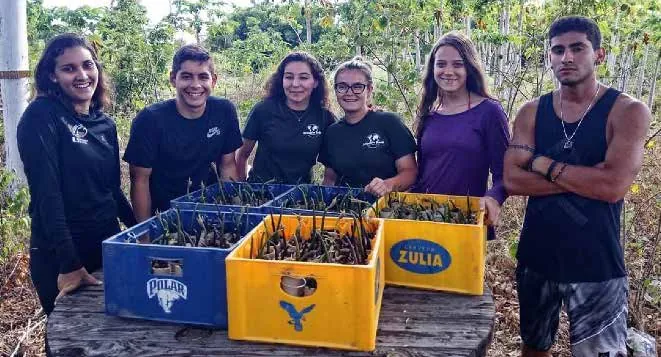
Terence Ching has worked in Curaçao’s nature parks since he was fourteen. After an oil spill damaged an important mangrove area, he founded the COIA Foundation and its Mangrove Adoption Program: individuals, schools, companies and even nursing homes raise mangrove seedlings until they are strong enough to be planted in the wild. The program restores coastal habitats, creates green jobs and grows bottom-up, with the people who have cared for these places all their lives.
“Together we are stronger.”
Terence has been active in nature conservation since the age of fourteen; first as a ranger, then as a park manager. On the island of Curaçao, there are more than 37 nature parks, many of which lack official status but are maintained by the local community. Terence began his work in these parks and soon realized that environmental management was not merely a job, but a culture of care, in which the island’s residents are an integral part of the ecosystem.
Traditionally, the upkeep of these parks was carried out by foundations that often worked in a top-down way. Terence saw things differently: he believed in a bottom-up approach, working directly with the people who had cared for these areas all their lives.
This belief led him to establish the Curaçao Outdoor Industry Alliance (COIA) Foundation, a diverse collective of island residents who recognize the value of both nature and community. The foundation follows a clear philosophy: all incoming resources go directly toward project development, while any remaining funds are placed in a trust that supports the participating communities. Individual profit is not the goal; the focus lies on shared environment, shared responsibility, and shared benefits.
Motivation
Where does your passion and motivation come from?
“For me, it all started in 2014. The idea to start the Mangrove Adoption Program actually began two years earlier, after an oil spill in 2012 severely affected an important mangrove area on Curaçao. The damage we found struck me deeply. The pollution was not just an isolated incident; it revealed how fragile the ecosystem had become due to historical ecological disruptions. What was once a fertile and productive wetlands had during colonial times been transformed into commercial saltpans, causing ecological degradation and loss of biodiversity. Areas that, with the help of local residents, have now been given the chance to flourish into parks, recreational areas and biodiversity hot-spots. However, the threat of restrictions and inaccessibility remains, as locals lose to developers and entities in positions of power.”
“When I saw how nature, despite everything, had demonstrated its resilience between 1983 and 2013 and how biodiversity had recovered to the point of receiving international recognition, I realized something important: the power of recovery, of life finding its way back despite human mistakes, profoundly inspired me. It gave my team and me hope. If nature itself has the resilience to heal, then we, as people, must support that strength instead of undermining it. That understanding became the driving force behind the foundation: to help restore more areas on the island, together with the community, and to show that restoration is not only possible, but begins with taking responsibility.”
About the project
Can you tell us what the initiative is about?
“The main project I am working on with my foundation is the Mangrove Adoption Program (MAP). This initiative focuses on restoring and strengthening mangrove ecosystems while involving people in building a future that is both climate-resilient and socially stable. Through MAP, we aim to revitalize degraded areas, build resilient coastal habitats, engage local communities, and create sustainable employment opportunities.”
“What is beautiful about this program is that everyone can participate. Individuals, schools, companies, and even nursing homes take care of young mangrove seedlings until they are strong enough to be planted in the wild. In this way, not only does a tree grow, but also a sense of responsibility and connection to the environment.”
“The program is built on several pillars: raising awareness about the importance of mangroves for coastal protection, biodiversity, and CO₂ storage, active restoration through planting, and involving local actors so they can take ownership of environmental management. This approach fully aligns with my belief that conservation should not be organized top-down, but should grow from within and with the community. For me, it is not about “planting trees” as isolated actions, but about building sustainable systems, creating jobs, and inspiring a cultural shift in how we relate to nature.”
What inspires you?
“What inspires me most is seeing change, especially when something that was once resisted is eventually embraced. In the beginning, it was not easy. Government bodies and established institutions were not open to our innovative approach; we even received letters telling us to stop. Still, I kept believing in the power of working together with the community and following what felt right. Now I can see that persistence pays off: our work is being recognized by the government and is now part of strategic frameworks, such as the National Biodiversity Plan. Seeing that transformation reminds me that change is possible, and that continues to inspire me to move forward.”
Youth and climate action
“In the coming years, I want to use COIA to restore more areas that have suffered ecological damage in the past. My goal is not only to rehabilitate these landscapes but also to create sustainable jobs within the green economy, ensuring that environmental restoration goes hand in hand with social progress. I am also working to anchor the organization’s funding mechanisms to ensure that COIA can continue to exist for generations to come.”
“For me, it is absolutely clear: nature is not something that belongs to us, we borrow it from those who come after us. That understanding lies at the heart of my work. Stewardship and shared responsibility are to me the foundation for a future in which people and nature can grow together, in balance and mutual respect.”
Do you have a message or tip for other young people who want to take climate action but don’t know where to start?
“Yes, my main message to young people is: go out there and do it. Do not wait for permission or for the right moment to begin. You do not need to think big right away; small actions can make a huge difference in your own community. Plant a tree, join a cleanup, or start a conversation about what nature and climate mean to you. By starting today, you inspire others to do the same, and that is how real change begins.”
From the COP30 storybook of Jonge Klimaatbeweging (2025). Text: Stephanie Okafor, Lot Schuijer.
Comments