Fresh water from seawater, with algae
Meinke van Oenen founded Algaenius, which turns seawater into usable fresh water with halophilic algae. The algae absorb most of the salt while capturing CO₂ and removing pollutants, without the energy use and toxic brine of reverse osmosis. Water scarcity is coming, even to the Netherlands; her answer follows her own philosophy: look at nature, find the future.
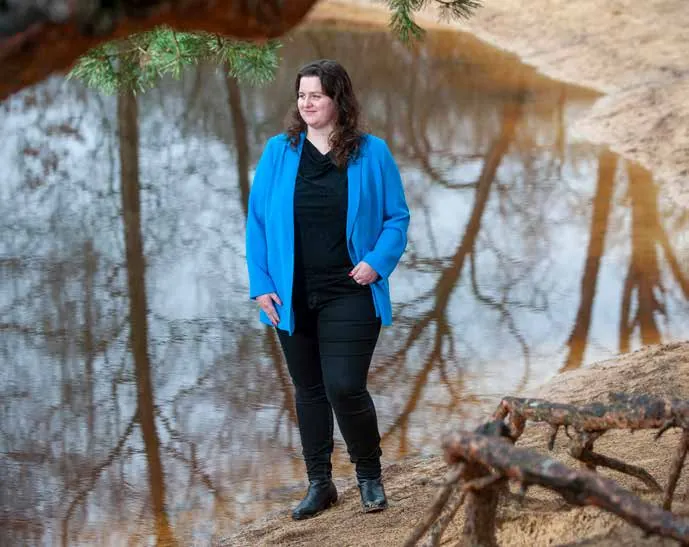
At just 21, Meinke van Oenen is pioneering sustainable desalination, transforming seawater into usable fresh water through natural processes. A multi-award-winning innovator and founder, she combines systems engineering and business administration with her passion for nature-based design.
Her company, Algaenius, develops the first (bio)desalination method using halophilic algae. This technology produces water suitable for industrial, mining, and agricultural use while capturing carbon and easing pressure on freshwater sources.
Now completing a minor in Biobased Sciences at Wageningen University, Meinke plans to pursue a master’s degree after graduation. Guided by her philosophy, “Look at nature, find the future,” she aims to build a business model where ecological and financial sustainability go hand in hand.
Water scarcity as a wake-up call
“Climate change often feels distant,” Meinke says, “but water scarcity is real and accelerating.” By 2030, even the Netherlands will face shortages (National Institute for Public Health and the Environment, RIVM), and globally, two-thirds of the population could be affected.
Most current desalination methods rely on filtration and fossil fuels, creating costly, energy-intensive systems that worsen emissions. Meinke’s solution emerged from a question: Can we make water accessible while helping the climate, not harming it?
Her answer was algae.
“I truly believe that effective solutions must work with, not against, the environment.”
Algaenius: nature’s genius in action
Algaenius uses specially cultivated algae that absorb 70 to 90% of salt while capturing CO₂ and removing nitrogen and other pollutants. “Like tiny Pac-Men in the water,” she says. The result is reliable, low-salinity water for industries and farms.
Unlike reverse osmosis, which demands vast energy and releases toxic brine, Algaenius offers a low-cost, circular process. Salt and carbon are locked in the algal biomass, which can then be reused or safely processed.
Currently at Technology Readiness Level (TRL) 4/5, Algaenius seeks pilot projects to scale its solution. Its early success has been recognized by the UN Gamechanger Challenge and Dutch Junior Water Prize, proving that nature-based innovation is viable and necessary.
Learning from nature’s intelligence
When asked what Meinke finds so inspiring about Algaenius, Meinke shares, “is nature itself, its adaptability, its genius. When you look closely, everything in nature collaborates and coexists. We have a responsibility to follow that example.”
Her goal is not only technological success but to inspire others to innovate with nature. “We can all be that small stone in the river that creates ripples.”
Scaling up, thinking globally
Next, Meinke aims to validate the market and expand internationally. While the Netherlands acknowledges water scarcity, innovation in desalination is slow. Southern Europe, the Dutch Caribbean, and South Africa show greater readiness for testing and scaling.
Algaenius also targets industrial wastewater and brine discharge, a growing global concern. “In Belgium and the Middle East, brine is dumped back into the sea, harming ecosystems. Our method can biologically treat this water while sequestering CO₂,” she explains.
The next step: scalable saline-water treatment using algae, an approach that combines climate mitigation, biodiversity protection, and circular design.
Scaling a global solution
For now, Meinke focuses on validating her model in the market. Southern Europe, regions like Spain and Italy, has shown greater openness to desalination innovations than the Netherlands. “Other promising markets include the Dutch Caribbean and potentially South Africa,” she explains.
Her vision remains international. During the UN Gamechanger Challenge 2023 in New York, she met a South African engineer who is now a strategic collaborator. Together, they hope to expand Algaenius once funding and pilot opportunities are in place.
“The next steps focus on scalable, nature-based wastewater treatment,” she says. “By harnessing algae’s resilience and efficiency, we aim to provide a technically viable, environmentally friendly, and globally relevant solution.”
“Working with nature might just be the smartest technology we have.”
Motivation through challenge
What keeps her going, even when things get difficult? “I think it’s partly about switching a mental button, almost like saying, ‘Okay, let’s just do it,’” she says. “A lot of my inspiration comes from nature itself. When you pay attention, it’s incredible to see how everything comes together in symbiosis. That’s what motivates me to keep working on Algaenius every day, even when it’s challenging.”
Message to decision-makers and the next generation
When asked what she would tell decision-makers and the young people who will shape the future, Meinke offers a clear and grounded reflection.
“The world is on the brink of a water crisis. By the end of 2025, half the global population will live in water-scarce regions. In Europe too, droughts are intensifying. We can’t keep relying on energy-heavy, short-term fixes. The only scalable, affordable way forward lies in nature-based solutions, they capture CO₂, regenerate ecosystems, and restore balance.”
Her message extends beyond policymakers to the next generation ready to act. “The key is to enjoy the process,” Meinke says. “Working toward a big goal isn’t always easy, sometimes it’s exhausting, but those moments of challenge are what shape you.
Rutger Bregman calls it moral ambition: if you have the privilege of opportunity, you also have the responsibility to use it for good. Start where you are, don’t fear failure, and remember that even small steps can create lasting impact.”
Other projects
Are there any other projects or initiatives you’re currently involved in?
I’m currently an ambassador for Techkwadraat, an initiative by the National Growth Fund that aims to promote high-quality technical education. In addition, I’m a member of the Advisory Board of the Technasium Foundation.
The world is facing an unprecedented water crisis. By the end of 2025, half of the global population will live in areas affected by water scarcity, and within five years, around 700 million people may be forced to migrate due to lack of water. Europe is not immune. Last summer, several regions experienced severe droughts, and even in the Netherlands, the RIVM predicts a structural drinking water shortage by 2030.
As with many other challenges, most proposed solutions focus on symptoms and rely on technologies that consume vast amounts of energy. We need to fundamentally rethink our approach and seek solutions that address root causes, ones that also capture CO₂. Otherwise, we risk a vicious cycle of new problems. The only truly scalable and cost-effective way forward lies in nature itself. Nature-based solutions are the future!
From the COP30 storybook of Jonge Klimaatbeweging (2025). Text: Stephanie Okafor, Lot Schuijer.
Comments